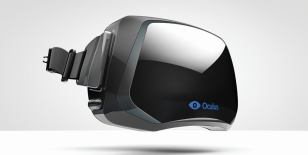
If there's one big trend that has been taking over in the last few years, it's VR. After the successful kickstarter of the Oculus Rift, the VR market has been revived after about two decades from its original demise. The VR market has become a huge deal for developers, publishers and hardware makers. But as Game-Wisdom's resident cynic of VR, I have my concerns I want to talk about.
The Consumer Base:
If you've read any big piece on VR over the last few years, it's always from the enthusiasts and tech people. These are the people who are already enamored with VR and understand its utility. That's all well and good, but we're missing an important group: The consumers.
There's very little info on what's the interest level of everybody else. People like me who only remember VR from the 90's and The Lawnmower Man. If you remember, Nintendo was banking on motion controls to be the next trend to capture everyone's attention. Unfortunately, while it worked in the short-term, it didn't last.
The problem isn't generating excitement, but creating a market that will continue to grow. Once the initial excitement about the Wii was over, the market stopped growing.
With that said, there's more about the consumer base that has me concerned, and the first one is the price tag.
The Investment:
Anyone who knows technology and new hardware understands how the cost works. The first of anything is going to be expensive, because the market is still being determined. With VR now, we are seeing everyone try different prices to see what will be the most acceptable.
The Oculus Rift at this moment is $599, while the Vive is $799. Then there are the console versions, with the Playstation VR retailing for $399, but needing the PS4 to work. But there's even more to talk about.
With the use of crowdfunding and growing interest, companies are jumping on the VR bandwagon with all kinds of devices and peripherals. I've seen the Omni treadmill, controllers designed to simulate weight and there's more that I'm not even aware of.
That raises one very big question: For the consumer to get the true VR experience, how much is it going to actually cost?
Speaking of cost, there is one other aspect of investing in VR that we need to bring up: real estate. Let's face it, finding the room for all of our hardware can be its own nightmare.
Some households and apartments just don't have the space. From what I've seen with VR now, you need to have a pre-defined area of room and motion to make use of it.
I had enough trouble setting up Rock Band for a few people in my house. I can tell you that there is no way I’m fitting an Omni treadmill anywhere in my house. I recently saw a VR game with the floor being hot lava; there is no way in hell I could ever play that here.
The more demands a product has for you to use it the less appealing it's going to be to a wider audience. With that said, let's talk about what we're actually going to be playing.
The Games:
There is a big difference between a game that uses something as a gimmick or as a fully integrated element. During the motion control era of the Wii, many developers added in motion gimmicks to their design.
Outside of a few games that fully embraced it, most motion-based mechanics were superfluous to the game. That raises a serious point about VR and Games: How many games are going to be made that could not work without VR?
If you're trying to sell someone on the use of something, you need to show them something that they wouldn't be able to do otherwise. We can talk about the sensory experience, but that's secondary to the actual gameplay.
For this point, I want to talk to you: What are some original games that are being developed fully around VR? What I mean is a game that literally could not be played without VR.
To be fair to this point, I know that there is a lot of interest in the non-game use of VR: Simulators, therapy, AR in our daily lives and etc. The question remains though: Will there be games to justify the VR Game market?
The Standard:
Finally, my last major concern is a combination of the other three. In the past, the game industry had a decade of everyone trying to be the standard for the industry. Each platform developed its own technology and inputs to try and become #1. It wasn't until the early 00's and Sony and Microsoft before things settled down into the state we're at now.
The problem with VR compared to other platforms is that it's not a "platform" per say. No one truly owns VR, which is why everyone is developing hardware around it. Without having a standard, I can see similar things happening to VR like the peripheral music genre from a few years ago.
Everyone was trying to get into it and releasing their own hardware; flooding the market and making it a confusing mess. To make things worse, compatibility with the different hardware is going to be a nightmare as more people, companies and tech get into the market.
From a consumer point of view, I wouldn't be spending hundreds of dollars on hardware now until things have quieted down.
However, "quieted down" is code for several companies going out of business or dropping out of the market.
A Crazy Couple of Years Ahead:
At this moment, the Oculus Rift and the Vive are both out, with Playstation VR coming this month. That means 2017 will be the first year in about two decades that we can see the full impact of a VR market.
We don't know right now if VR will be the next Smartphone or the next motion control fad. This is one of those posts that I'm going to end things with talking to you: The reader. If you own a VR device now, what do you think of it? If you're like me, what is giving you doubts about VR?
Where things go from here is anyone's guess. For me, all I know is that 2017 is going to be an interesting time for the VR market.
Microsoft announced its financial results for Q3 of fiscal year 2026, including an update on its gaming Xbox business and more.


Not looking good. Hopefully Asha Sharma is able to turn Phil’s disaster around.


To me it's still quite remarkable how they can cash-in 5.3bn in revenue in a single quarter, since their hardware is basically dead.


The charity event will be streamed live from Gamescom in August.
Thanks to the slip-up of an artist working on the title, we now have more evidence that a new Injustice game is in the works.




Well said. Not really jumping on the VR express either. The price alone is enough to deter me, but just the thought of having a giant pair of goggles on your head, surrounded by cables and wires doesn't sound appealing to me in the slightest. Take the comments from this one review:
_____________________________ ______________________________ _ ______________________________ _
"Setting up either of the two existing PC-connected VR rigs isn't pretty. The same goes with the PSVR. It's not an overly complicated process, but the interconnected wired web that results isn't necessarily something you can tuck away out of sight.
You'll need an extra outlet to power the PSVR's processor unit and you'll also need to devote one of the PS4's two USB slots so that it can talk to the console. The unit is about the size of three CD jewel cases stacked on top of each other -- this of course needs a place to live as well.
The whole thing took me about 10 minutes to connect my first time. When it's all done and dusted, what you're left with feels inelegant and messy, but part of VR is being tethered to a long wire. That's just where the tech is right now. Compared to the Rift and Vive, the PSVR is no better or worse in that department."
_____________________________ ______________________________ _ ______________________________ _
For someone who absolutely loves having a clean entertainment setup, this would drive me crazy!
Then there's also the health side of things, in the same article he says this:
_____________________________ ______________________________ _ ______________________________ _
"But, it can also make you dizzy. If the camera isn't tracking you well, the artificial floor can start to drift while playing. That's a weird feeling! It feels like you're drunk and can't hold yourself up."
_____________________________ ______________________________ _ ______________________________ _
We have no idea what the long term health effects are of VR. Sure the issues stated above aren't dangerous by any means but still. This is a technology we've never fully utilized for consumer use before, the effects could be entirely minimal, or quite drastic. I don't think a study would hurt the matter.
Before anyone says it, YES, I have tried VR, specifically Oculus Rift, and while I found the technology to be quite impressive, I see it nothing more then a fad that'll fade off within a year to couple years time. It heavily reminds me of 3D TVs/goggles....look where that went.
I know I'll get alot of disagrees with this, I'm sure certain fanboys will come out and call me a troll. But I'm not. It's my opinion, it's what I feel on the matter. If you're supporting VR, good for you, I hope you enjoy it. As for me, I'll respectfully pass on it, gaming on a 55inch 4K TV sounds more exciting to me.
VR arcade or more importantly the return of videogame arcades due to VR technology. The author is right, at the moment VR is expensive, lack of space, etc. ; hence, VR arcade 😄