
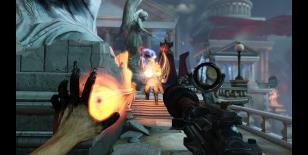
The ways we look at a game are often as important as they ways we play them. Our own two eyes are the most powerful windows that we experience the worlds games developers attempt to immerse us in and the point of view they lend us can wreck or reward a game in a variety of ways. Games bombard us with visual aesthetics between first and third person shooters, from Bioshock Infinite to Uncharted. It was while playing the former recently that I thought to myself in passing: “Am I looking at this or is someone else?”
Immersion, the enjoyable kind or the not so enjoyable kind, is always the first consideration I take whenever I think back to my favorite games. Looking back on a few of my favorites like The Legend of Zelda: Twilight Princess or Assassin’s Creed II, I can say that I empathized with my characters so much more than Infinite’s Booker DeWitt or Mirror’s Edge’s Faith, maybe because I was able to see and hear them like a movie character rather than walking around in their own bodies myself. From a third-person perspective, I could recognize their movements and familiar faces than when I was a floating, bodiless camera cruising smoothly along the surface of the game world.
That’s quite the opposite to the common wisdom that’s dished out in game theory. Games are always advertising the next step in being the character, so it’s difficult to know why I’m more entertained by merely watching them obey my every command.
The problem may very well lie somewhere between the principles of immersion and character-identification, principles that aren’t always the same. They’re both related and complement each other, but they also operate independently and in different ways. The first is persistent in its attempts to make us feel more like we’re the conceptually literal people onscreen. The second further removes us from the action as a spectator but nonetheless engages us in analyzing the situation at hand rather than being in the midst of it.
First-person immersion often relies on the idea of transportation from our world to the game world. The FP player is injected into the gameworld as a non-character in the fiction as a digital shell, requiring you to inhabit rather than become a fictional entity. That’s certainly the case for a Portal-style game where there’s no definite personality to speak of. The player literally imagines Chell’s reactions and thoughts as they go in stark contrast to any dramatic narration. The key is that the player-character isn’t a “character” in the normal sense of the word at all. Rather, it’s a transparent experience, more like the interface of a mouse and keyboard that allows human players to act within the digital realm. Players aren’t engaged with the character at all, but with everything else in the game world.
From this perspective, we can’t even say there’s anyone called Chell or Gordon Freeman. We’re the ones that shoot baddies and solve puzzles, and that can stretch the game’s sense of believability. I myself would arguably not make a great physicist or be very handy with a portal gun at all. We’re always acting as someone else in someplace else, so it makes more sense to complete that role with a definitive, other worldly personality. Very little of who and what players are helps video-game storytelling, especially the alien-slaying, puzzle kind. To survive that have to become someone else. Or, I don’t want to be me, but the me I so imagine or dream of becoming.
Even without any hard bar graphs or charts, I’d suggest that a lot more fan fiction exists for the average third-person player-character than any average first-person character. The former’s consistent appearance and memorable movements are especially important to characters like Uncharted’s Nathan Drake and Beyond Two Soul's Jodie Holmes. I still know more about either of them as human beings than I do Chell simply from a camera angle. I suppose “fleshing out” a character’s body is one of many important ways we’re able to create more convincing fictional characters in games. All the better to know more about that role we’re assuming.
The physicality of our humanity disappears almost entirely in a first-person game. In Bioshock and most FPSs, the designer and player are both allowed to forget about how a human body moves. Inhuman strafing and spinning are based more on controller sensitivity than footwork. In the Elder Scrolls: Oblivion, players glide across torn landscapes with the fluidity of a hockey puck on the ice. Compare this to the imposing presence of Arkham City’s Batman. His punches crack thugs’ faces to the sound of thunder and we feel appropriately heavier as him than as Drake, and even Infamous’s Cole McGrath. We see Cole make every footfall and handhold count as scale Empire City’s scaffolding and get a better sense of his ability as well as our own as we play him.
More than that, third-person games represent theatrical role play. The more I know about a character, the more I can become them. It’s how actors play roles. To argue that a player can’t “become” Drake, Cole, or Batman, because they’re in physical view is comparable to arguing that an actor can’t “become” Hamlet because there isn’t a script detailing what or how they should perform. If you’re the actor, there isn’t another Hamlet apart from the one you’re playing on stage. Obviously, you can’t see yourself as Hamlet as he can’t see yourself from behind, but you absorbed his description before show time while studying the script and carefully rehearsing the role. Maybe if the first-person game encouraged me to go to such lengths, I would experience a similar level of empathy for that invisible character. To do this, however, that character wouldn't be the same blank-slate they usually are.
Some still defend first-person immersion for their greater connection to a character and eliminating a sense of puppeteering. That’s more theoretically successful than in practice. For me, first-person games struggle with physical translation. By design, FPs have players viewing through their own set of eyes through yet another set of eyes: the character's. That can inherently create a euphoric double-take of looking at the world through a virtual mask that only confirms to you that your protagonist is a hollow shell. Third-person perspectives by contrast embrace the role of a looking glass that may not allow you to be the character, but feel like them.
I feel that’s only the case as long as we’re restricted to our TVs and computers. With the advancement of the Kinect’s motion control and, more important, the Oculus Rift, more players will be able to move and control their characters without the intermediary of the screen. It’s then that first-person perspective might finally dominate the gamer landscape as our character movements are literally and unequivocally our own and not through any controller at all.
It essentially boils down to vessel versus complete characters for my gaming. The first-person characters will always feel like a more make-believe character I’m improvising as I go. In third-person games, that character is a richer, more definable character I can inhabit and experience. That doesn’t explain everything I dislike or find lacking in Bioshock Infinite or Half-Life, but the hollowness I feel in my character is certainly a factor.
I might be a far less imaginative person for it, and I can’t say that I haven’t enjoyed games from both first and third-person perspectives, but I’ll always find a kindred spirit in the latter.

Microsoft announced its financial results for Q3 of fiscal year 2026, including an update on its gaming Xbox business and more.


Not looking good. Hopefully Asha Sharma is able to turn Phil’s disaster around.


To me it's still quite remarkable how they can cash-in 5.3bn in revenue in a single quarter, since their hardware is basically dead.


The charity event will be streamed live from Gamescom in August.
Thanks to the slip-up of an artist working on the title, we now have more evidence that a new Injustice game is in the works.




The problem with first person is that your character always suffers from tunnel vision in the game.
Do this right now, look at the image posted above and stretch your arms out in front of you.
Can you only see a tiny bit past your left pinky like in the above photo or can you see a lot lot more?
This might not sound like a big issue but not only does it provide an unrealistic point of view it also restricts how much will visibly be going on screen at once which effects strategy.
This is why I prefer 3rd person games as they allow you to see a lot more so that when you come across someone you can act more appropriately about the situation. Not just oh someone there bang dead or bang got them.
i just feel weird playing FPS. not being able to see where my supposed body is doing is strange. I think that the main difference there is that even though we don't really see our bodies in real life our senses give us this positional awareness. In FPS you only get one part, the eyes part and not anything else so you have to adjust more, even if subconsciously. I think they get in the way of immersion because its always there in your face: "you're pretending you're inside the game but movements and awareness is unrealistic".
besides, its just ridiculous to play an entire game as a cross-hairs.
First person view brings more immersion and horror!