

I've been meaning to post something like this for a very long time and I'm not sure I'll have enough time to post everything I'm trying to get across, but if you're one that's been waiting for gaming journalism and gaming in general to grow into something more. Such as being included an undergraduate gen ed course in colleges and to where academic papers are written on gaming then please keep reading.
Somewhere along the line we need to start defining what makes a good game. And I don't mean we should try to box gaming into one term... It's more that we should be able to point out elements that make a good game. In relationship to film, if we look at the ( http://tinyurl.com/76bhck3) five principles of film form, we will notice that they are not specific things like 'fun' or 'graphics' or even 'audio'.(yes, obviously film would not mention fun or graphics but just follow me here...). Terms like fun cannot be defined because they are dependent on the viewer itself and therefore cannot be evaluated. Please do not take this as a game can not be described as fun, there is nothing wrong with the idea that a game being fun is the core element of a game. What I am trying to say here is that just saying it is fun not enough and there should be some sort of criteria or approach that was done which made the game being evaluated fun and we should be able to point that out.
Instead let's say, what if we did see how a game met function as defined in film. Now of course gaming is going to need it's own criteria but for now let's go ahead and just show a broad example. Is everything the user is seeing/ experiencing/ or able to do contributing to game or necessary for the overall plot or enjoyment of a game. I.E. if a game allowed a players to have his character open up his jacket to see how many bullets he has. Is this element there to immerse the player, is it meant to portray anything about the main character? Basically, if we took out a feature, would anything of value to the overall experience be lost? Whether the answer is no or yes does not really matter but the point remains that this type of analysis can point out what makes a game good or bad. I believe games that are truly good will have more elements that can answer yes than elements that are answered by no.
When it comes to mis en scene where everything is on screen for a reason. If you walk into a boss fight, everything you see on the screen should be there for a reason. I.E. some things are there to assist you in how to fight the final boss. But there should not be something that is there just to fill space without providing any significant contribution to the overall experience of the boss fight. This is pretty basic but Bioshock does a really good job of putting things on screen that add to the plot or tell you a little tid bit that makes the underwater city that much creepier/interesting.
I'm not going to go through everything but once we define all parts of games we will be able to easily point at sections where a game prospers and where it lags behind. And again, I'm not talking about "this part was fun". I'm talking about how different elements that are defined in the basic principles of gaming came together to create that portion of the game that everyone describes as the "best part of the game" or "a revolution in the genre".
I'm gonna change pace a little and jump to how eventually gaming could get beyond the basic definition phase. I.E. One basic definition of film is that "Film is a collaboration of artists, cameraman, editors, directors,musicians, audio engineers,ect". I would argue that gaming is also a collaboration of testers, audio engineers,programmers, network engineers, artists, Animators,Designers, and software engineers. Already people seem to believe that people like david jaffe,Tim Schaffer, and miymoto are what is behind a game and they have the most influence of game. As it is their vision (or their understanding of mis en scene)that makes the game so damn good. This idea is very similar to "auteur theory" in film that says film is a creative work and is entitled to personal authorship as any creative work such as literature or music. One criticism of this is that is goes against the basic definition of film that "film is a collaboration". This is the first kind of theories I see developing in the second phase after the initial definitions have been defined agreed upon for the most part.There will always be criticisms. There always is on things that prove or define anything.Yet, a response to a work that is trying to do prove or define a part of gaming is not an insult, but rather an academic attempt to improve upon work that has already been done.
I would love to see the previously discussed kind of theories being thrown around in gaming because until then... gaming is still growing up. If gaming is going to grow into something much larger than it is now. (Believe me, it really is something right now.[face_cool])Then it must be approached in a way that is more than "I enjoyed it, or I did not."
I really wish I had time to extrapolate further but I don't. And I'm not saying gaming should be like film. I'm just saying we need to become our own art form with our own academic analysis for it and film is just what I used as an example. I can point out right now that a big hurdle gaming will need to do is find a way to define the players interaction in a way that gives the creator of the game a certain control over it because they do and that should be included in the definition. The second hurdle will be finding a way to include multiple player interactions such as co-op, online, and other social interactions.
tl dr; Sorry, if you're not going to read, this really isn't a discussion for you as this is an academic approach to gaming in order for it to become an accepted art form.
Always with a grain of salt,
~Wardog1368
NOTE: I do realized I've understated or not thoroughly explained some of the film aspects I spoke about but I just stated enough to allow the reader to understand.
Microsoft announced its financial results for Q3 of fiscal year 2026, including an update on its gaming Xbox business and more.


Not looking good. Hopefully Asha Sharma is able to turn Phil’s disaster around.


To me it's still quite remarkable how they can cash-in 5.3bn in revenue in a single quarter, since their hardware is basically dead.

The charity event will be streamed live from Gamescom in August.
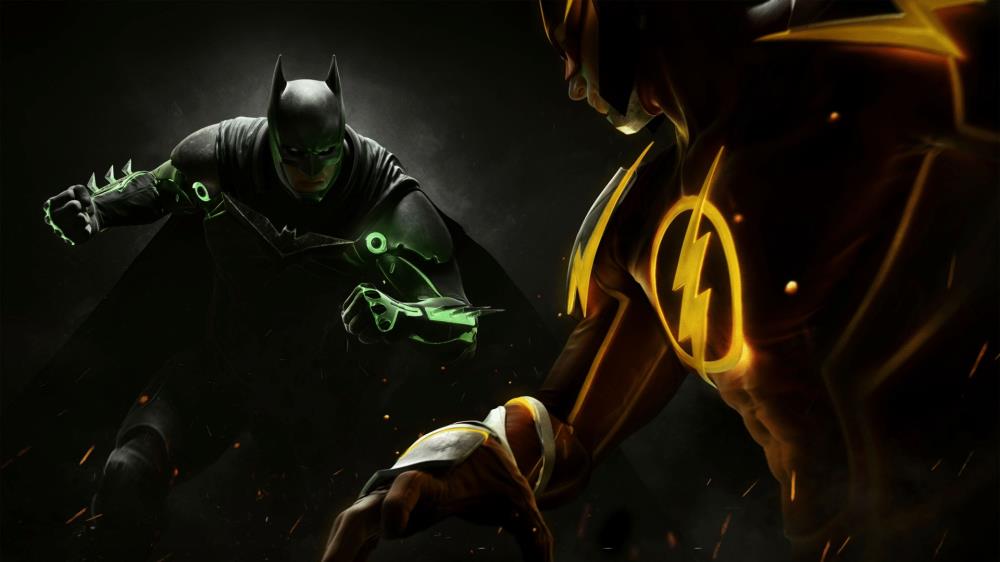
Thanks to the slip-up of an artist working on the title, we now have more evidence that a new Injustice game is in the works.




If you think video games are art, then they are already art. Some people don't think Andy Warhol's pieces are "art", but others would argue that they are. "Art" holds a similar meaning to the one you've given "fun" here, it depends on the person.
In terms of the mainstream "art world" it will take either an established "artist" making a video game, or a fad period where video games are the "it" topic to drive them into that world.
Do you really want that though? A bunch of out of touch yuppies bidding on a video game because it's become a status symbol? Or would you rather have a group of people who actually enjoy video games discussing what they like and owning things based on their preferences? Because the "art world" is all about status symbols.
Thats the thing see gaming is NOT simply just an "art" as some "artists" would have you believe.
It is the sum combination of all these "art forms" i.e film, art, music into one interactive format.
They use art to design a games looks, they use music in game to set the mood and or tone and they use film esque techniques i.e camera angles, script writings etc etc
SO in my opinion "art" is beneath game design as that is only one aspect of what makes a game.
These "artists" who refuse to accept games can live in their ignorance for all I care.
Video games are the 'Versailles' of new media entertainment. It gathers motion picture, music, technology, painting, sculpture, design, etc...etc... It's the pinnacle of all of the entertainment. And has the single aspect that others don't have. Interactivity. Gaming will keep on growing. Just look how much it developed in the last 30 years. And it will continue to develop and grow. Who knows if gaming won't became those sci fi 3D hologram training rooms kind of thing?
You can have a game as simples as LIMBO and a game as complex as Uncharted and both critically acclaimed.
Soon movies will became like Heavy Rain or Uncharted, music will present such interactivity aswell and even TV and internet will be a part of the 'video game'. Because video game is a much more wider concept that just shooting people or climbing stuff. It's all about interactivity, living an transcendent experience.
Btw, you can't define what's art or what is not. But that's a much more difficult and longer discussion that doesn't have a definitive answer. It's like saying Dubstep isn't music. Just because you don't recognize it as music or don't like it, doesn't mean everyone else has the same opinion as you or that it isn't music after all.
For example, I find contemporary art very interesting and intriguing. I seriously prefer and value more works like Malevitch or Mondrian than a guy that perfectly draws a horse or paints a woman. But that's also because people are 'afraid' of the uncommun and prefer and value things they know or they think the know.
Too much philosophy for a gaming site I'm afraid.
Call me a philistine but if this:-
http://www.saatchi-gallery....
can be recognised as art, then so can the contents of my nostrils.
My point being that this demonstrates that art is subjective and a criteria for evaluation seems a little harsh when it comes to film or games when it's clearly not adhered to with other forms of art.