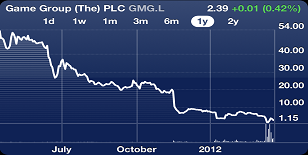
Despite a tumultuous six weeks and countless blogs heralding the demise of the high street retailer, GAME Group was rescued in a dramatic eleventh hour deal by OpCapita on April Fools’ Day.
Whilst some have argued that the joke was on the white knight investment firm, recent events in other areas of the economy might actually turn the tide in their favour, provided they can streamline their business model.
TIMELINE TO ADMINISTRATION:
29 Feb 12: GAME announces it will not be stocking the highly anticipated (and heavily pre-ordered) Mass Effect 3. Share prices plunge 20%
15 Mar 12: GAME announces other supply streams have dried up. Along with EA, Microsoft and Activision have also withdrawn lines of credit. Share prices crash.
19 Mar 12: GAME requests that the company’s shares are suspended from the London Stock Exchange.
26 Mar 12: GAME enters administration. 277 stores close immediately, 2104 staff are lost.
CURRENT STATE:
Ultimately, many industry analysts were not at all shocked by the events leading up to administration. The writing was on the wall for some time: a fragmented business model, an aggressive sales strategy overly dependent on pre-owned titles and a heart attack in rent arrears for properties within spitting distance of each other, all combined to create a perfect storm that could not be weathered in the current economic climate.
The above factors do not even take into account competition from the online marketplace, which remains GAME’s frontline. But two events have recently transpired which may level the playing field:
On 1 April - the same day GAME was saved - HM Revenue & Customs (HMRC) closed the Low Value Consignment Relief (LVCR) loophole. Previously this tax relief had allowed online retailers like Play.com and Amazon affiliates, based in the Channel Islands, to reduce their administration costs and thereby undercut their ‘bricks and mortar’ competitors in the UK. The closing of this loophole may eventually reduce the online discounts on offer.
In other news, Amazon, Britain’s biggest online retailer, has found itself under the scrutiny of the UK tax authorities. Reports indicate it generated sales of more than £3.3bn last year but paid no corporation tax on profits from that income. Its UK arm is classed as an ‘order fulfilment’ operation and its tax affairs have been handled in Luxembourg since 2006, meaning it can charge VAT at much lower rates.
With the above tax avoidance schemes addressed, it may harmonise the pricing between high street and online retailers, but GAME still has a lot to do to.
FUTURE STATE:
As a child of the 80’s, I spent many a Saturday afternoon at a high street store in my hometown called Software City. It was a small, independent retailer, catering for all the popular platforms of the 8-bit generation (Atari, C64, ZX Spectrum, BBC Micro, et al). There were racks of cassette cases locked into little spindles (arranged in genre) which you could demo on the systems behind the counter. They regularly held mini tournaments and promotions. They engaged with customers and built loyalty. It was a fun place to be.*
With that in mind, here are some humble suggestions for an invigorated GAME:
1. The immediate closure of surplus stores up and down the country, whilst regrettable in terms of redundancies, gives the company a chance to solidify its brand identity. The remaining 333 outlets now need to get back to the essence of what a physical game store should embody: a place for gamers to socialise, get advice, try out niche titles and compete against like-minded people. Sales are a by-product conducive to that environment.
Nowhere was the above more evident than the inaugural GAMEfest event held in September 2011. I attended the opening day. It was a resounding success for all involved and I sincerely hope it is repeated this year.
2. They need to make their stores more inviting. The lucrative pre-owned market is a necessary evil for this generation, but perhaps they could monetise it more effectively by introducing a rental scheme on the ugly stacks of trade-in titles that are clogging the shelves. Tying this to reward cards and initiating monthly subscriptions would entice customers into the stores and guarantee a revenue stream. It may also appease developers, who are no doubt incensed at the extortionate mark-ups on some titles.
3. They could consider grouping content by genre, as a bookstore might. It emphasise that little extra level of detail and shows that the staff have taken the time to categorise stock. Having genre charts will no doubt turn gamers onto titles they may have previously overlooked and give focus to casual customers when browsing.
4. They should match their physical presence with their digital identity. GAME has a really good Twitter feed which interacts well with the online community. Their website is now back online. They could use social media to pull customers into their stores, whether it’s announcing events or possibly leveraging the online functionality of current gen handhelds, like StreetPass for 3Ds and Near for Vita. Incentivising customers to visit their stores to pick up digital content for their consoles will have a positive impact on sales.
5. The need to price aggressively. They can never compete with supermarkets using AAA titles as loss leaders, but they can afford to shave their margins and give customers a bit of value for money. Market research suggests people do shop around online for the best deals, but are still willing to pay a little extra for a personal service.
OpCapita executives are no doubt busy building a robust strategy to get the company back on its feet. There will be many people who don’t think it deserves a second chance. As an eternal optimist, I like to think it has learned some valuable lessons the hard way and will emerge stronger for it, with the customer now at the heart of any future initiatives. The loss of such a huge high street retailer would have had a devastating effect. Thankfully, it’s still all to play for.
*I realise my rose tinted recollections of a bygone era may be misplaced; nostalgia can be a lying bitch.


A review for the upcoming Steam Controller has slipped the embargo date, revealing the gamepad's retail price.
I figured it would cost more than it does. Im curious for sure. Will probably pick one up.
VR is transforming relaxation, mindfulness, and mental wellbeing through gaming. Here's some of the best
Today, Square Enix revealed several details of "Evercold", the next expansion coming for its popular MMORPG Final Fantasy XIV.


Interesting. I will try the base game free trial when it comes out. I heard you can try the it as long as you want with Lvl 70 cap.