[Continued from Part 1]
[NOTE: EARLY-GAME SPOILERS for Quantum Break below. In order to talk about it as I want to I have to write in detail about some of the early chapters.]
4.) Junctions – Quantum Break
After playing as the lead character, Jack Joyce, for all of the action bits in the campaign, each Act finishes with an interactive segment where players take control of the antagonist, Paul Serene. Unfortunately, this supplemental gameplay feature is where the game’s marketing spiel has propped up how “your choices will affect the whole narrative!” While I do think it’s worth some appreciation for what they do in their own right, it’s tougher to swallow when knowing the consequences from said action aren’t super-revolutionary because—obviously—the game still has a particular story in mind; having said that, the various effects specific choices have does feel a little bit more substantial than the typical TellTale game.
What I really want to focus on though is the way these Junctions are able to add some dimension to Serene. In the first act of QB, Jack essentially witnesses Serene, his once-good friend, make the call that gets his brother killed. It’s only about five minutes of cutscenes after that event we’re plunked into the role of this murderous bad guy. Or so we think. While providing a monologue for the player, we’re eased into the role of being the antagonist because of his relayed experiences since The Fracture and what he believes is the only way to save mankind. Even the very first decision between killing eyewitnesses or utilizing a more PR approach to the situation at the university provides an interesting viewpoint of Serene because of the outcomes he know will happen. Rather than the vague notification seen in other games, these Junctions actually divulge what exactly WILL happen if you make x/y choice, due to Serene’s ability to see glimpses into the future.
Beyond those positives, I also appreciated just how well each choice was fleshed out in its justification whichever way you went, both through collectibles and in-game dialogue. As mentioned before, the idea of the first Junction point being a choice between killing innocents or not seems like a simple one to make. But the justification and lengths Serene thinks he needs to go is adequately explored so quickly thanks solely to Junctions. While it’s a feature done in the past, it would be interesting to see more story-driven games put us in the villain’s shoes. Sure, the mystery behind some antagonists is more fitting but perhaps there’s a bunch of other nuanced ways to give our bad guys more complexity through contextually-consistent gameplay like QB accomplished. If big-budget AAA games are capable of finding ways then I’d say there’s still hope.
5.) The Dark Zone – The Division (Version 1.2)
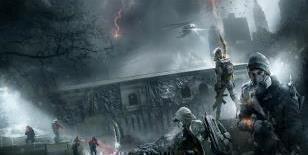
I’ll just come out and say it: some of my favorite online experiences of this year have come from The Dark Zone (DZ). The PVE/PVP mixture is the sole reason I spent about eighteen hours playing The Division during Memorial Day Weekend. It’s provided some of the most enjoyable highs and enraging lows I’ve experienced in an online title since…maybe The Wilderness in Runescape back in the day. Of course, I’ve been pissed off during online games before but, like in Runescape’s The Wilderness, it’s the possibility of finding some awesome firearm or armor that could all be taken by someone else that makes the experience so tense.
For those unfamiliar, allow me to provide some background. Most of The Division’s post-virus Manhattan is dedicated to PVE zones; killing mobs, finding groups for missions, and the like. The Dark Zone is a quarantined area OF Manhattan that’s only accessible via checkpoints. Each checkpoint has a small room with a vendor, restock station, and a stash for you to collect previously-contaminated items (more on that later). Once you leave this room and cross the plane into the actual zone itself you’re in the Wild West now. At any moment, players of levels close to your own (there’s level tiers like typical MMO’s PVP) can hurt you here; HOWEVER, since DZ’s rules operate on the non-aggression principle, the aggressor(s) will get marked as “rogue” and have a temporary bounty on their head for any other player to cash in should they take the call to kill him/her or the whole group marked as rogue. What possible incentives are there for going rouge? LOOT!
Acquiring DZ loot operates the same as in the rest of the world with the only difference being that it’s all contaminated. What that means is you can’t just get loot, exit through one of the checkpoints, and equip it for use; instead, it needs to be extracted via helicopter drop-off. This is where the real fun begins. Each extraction that any player tries to make is highlighted to everyone else in the corresponding-leveled Dark Zone Area. What this can mean for an individual or group are three of the longest minutes fighting off enemy mobs and the potential Rogue who wants to gun you down and take all of your contaminated stuff or hijack it by cutting the helicopter rope (this came in Version 1.2 of the game which is when I started playing DZ).
The brutality of it all comes down to the fact that death, via AI or Agent, results in all of your contaminated stuff free for the taking. This dog-eat-dog design philosophy is surprisingly brazen considering this is Ubisoft we’re talking about here. Going all out on the kind of idea that can result in losing an hour or two of someone’s progress is something that’d make any AAA publisher uncomfortable to back; yet, that’s the very reason I’m willing to accede that this mode is could be considered “iconic.” I cringe at saying that too, knowing who we’re talking about (4), but it’s so darn engaging to me. It opens up so many different dynamics of play.
-Do I try to team up with the first people I find?
-Do I try to act more docile or aggressive in ensuring no other Agents think of bothering me?
-Should I try to just piggy-back off of another player’s called extraction in hope that there’s still room to place my bag (max of 4 bags per extraction)?
-Should I engage or avoid that rouge agent nearby?
So many different possible stratagems can play out in your head in order to achieve this one goal: getting my awesome loot out of here. It harnesses and elevates the socially Darwinist game systems we’ve seen in the likes of COD because it expands beyond the trite gameplay formula of killing everyone in your way.
6.) The Walkie Talkie – Firewatch
Firewatch is one of those special walking sim/adventure titles that challenges one of the oldest tropes of its kind. The premise for the game is simple: you play as a fire watchman in the Wyoming wilderness during 1989. Since you’re in isolation while trekking through this open area the only means of communication you have with your boss is through this walkie-talkie. To me, it’s a neat idea because it provides legitimacy for the moments whenever the protagonist starts talking when using the generic ‘Look/View’ option seen in other adventure games.
It’s been the same old song for a while: the adventure game protagonist will start describing whatever environmental queue you clicked on despite being all alone—most of the time. A contrived method but it has served as a way of both allowing the developers to give hints about what to do next and provide more character for the protagonist. It was also very necessary in older adventure titles because of how little you could get solely by visually examining the environment. Yet even in today’s age with 1080P possible for point-n-clicks or adventure titles like TellTale’s games, we still accept this method of informational monologuing because it fills in the majority of our time alone with a greater understanding of our player-character.
That’s why I dig this mechanic used in Firewatch: it gives ample justification for doing this. Because Henry’s boss is on the other line of a walkie-talkie, it makes sense for him to describe everything he sees in detail; further, any sort of hints developers put in feels more natural and his character receives more dimensions by talking with his boss.
Conclusion:
So there you go. I guess the best takeaway from this that I can think of would be the following: if these are the kinds of fresh mechanics and ideas we can expect from the first-half of 2016, from both the indie and AAA sides of the industry, the future’s looking bright if this trend keeps up ‘til the end of the year.
Links:
4. https://www.youtube.com/wat...

Microsoft announced its financial results for Q3 of fiscal year 2026, including an update on its gaming Xbox business and more.


Not looking good. Hopefully Asha Sharma is able to turn Phil’s disaster around.


To me it's still quite remarkable how they can cash-in 5.3bn in revenue in a single quarter, since their hardware is basically dead.


The charity event will be streamed live from Gamescom in August.
Thanks to the slip-up of an artist working on the title, we now have more evidence that a new Injustice game is in the works.




I hope everyone enjoyed the 2-part blog. Sorry about that btw. I saw no feasible way of trimming it down to the 15k character limit that'd make the blog as detailed as I would've have liked. In the past, I liked when comments were funneled to the Part 2 section but I have no problem if you'd want to comment on the games listed in Part 1 in the Part 1 comments section. It's no bother either way since I'll keep an eye on both.
Now what do you think? Are there any other 2016 examples you can think of with bits of nifty game design not listed listed here? I haven't gotten around to all of them (obviously) and perhaps your responses could encourage me and/or others to check them out. :)
You need to play something From Software makes. They are number one in level design and detail those "WoW" map moments.
Good read ! I can not comment on any games you brought up in both blog post because i have not played them . But i can make comment on the new DOOM . I have been playing FPS campaigns for over 20 years . The new DOOM has brought back secrets ,somewhat non linear twisted level design and my favorite ,being able to dodge projectiles coming at you . Although the things i mentioned are not new, but has not been done in years on the level the new DOOM game has achieved . I believe developers of FPS campaigns today will now have to re-think the way they make FPS campaigns today due to the new DOOM game.
Sorry. With the "new" (see: poo) site layout this blog nearly slipped by. Not that I'm complaining. Lord knows the Internet's #freakshowonly mentality of negativity doesn't need me adding to it.
Anyway, nice blog beans. Who wrote it? :P