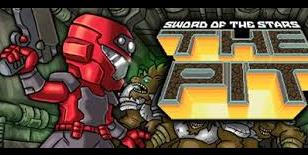
A surprise is what it was. Getting the opportunity to make another official review for an indie title and then suddenly realizing that I can’t recall ever having any involvement with another roguelike before which would allow me to compare and contrast my experience with those titles to Sword of The Stars: The Pit (SOTS) and the Mind Games expansion. Despite the fact that I’ve dove into what defines this subgenre and some of the most popular contemporaries, it’s tough to remove my trepidation tied with this heightened reviewing platform since half the problem could be considered against me just not being well-informed with these types of games in the long run. With that in mind, I suppose my future investment with this subgenre as a whole probably relies upon a specific quality title that would suddenly cause me to move past my inchoate experience and into becoming a bonafide veteran; something that SOTS just isn’t up to the task of accomplishing.
What began as a space-4X series of the same name, developer Kerberos Productions has now extrapolated the SOTS universe and plunked that into a roguelike dungeon-crawler template. The setting is Arbuda IV, a retirement settlement for hardened veterans uninterested in rest or active military service. A plague has spread wildly across this paradise and has turned humans into flesh-eating monsters. There’s currently no known cure. Hope lies within the Feldspar Mountains: an alien facility told in myths and ghost stories known as ‘The Pit’ may contain something to cure this ravaging disease. The only thing that’s certain is that anyone who’s gone into those mountains has never returned.
It’s actually funny to see how odd the first impression to a something so new to me turns out being, namely how confusing the shift in tone/character from the cool, techno-infused intro to running through a tutorial with an annoying Sergeant Gunny explaining the ropes. It may be something insignificant, since it is optional, but it rubbed me the wrong way into anticipating what actually turned out to be true: there’s really not a consistent personality here. For those that may have been invested in the space-4X titles, there’s probably a wealth of references in the environments or the bits of lore hidden within acquired messages—that weren’t very interesting to me, but very little else either has a sense of charm or the tense atmosphere the opening minutes teased this game of containing.
Inconsistency or just sheer un-remarkability are the kinds of traits that seep into the production values as well. There’s an obvious influence to that retro 16-bit artistic style shown just when looking at the main menu, UI, and such, but it’s all in the background of a cartoony, much higher-res character and monster models making the difference seem so terribly jarring. Beyond that, the art design takes some rather grand liberties of what to color these copy-pasted halls of decrepitude. The further you venture down these randomized areas, the more it feels like a set of levels were tasked by different hands using different perspectives instead channeling everything into one consistent art style and just expanding upon it. Sound regarding the chip-tune inspired soundtrack and effects is decent but becomes rather aggravating because how often a single music theme or slayed bestiary is just repeated over and over with no sense of uniqueness. And for what little voice acting is present (Thank God) in the forms of character-specific taunts and moments of spoken dialogue is pretty damn aggravating to listen to for hours on end. Given the history of roguelikes and many fans of them probably still enjoying the venture through ‘#’ caves as a random symbol, technical aspects in sound and visuals not being Kerberos’ forte will probably not be a hindrance to many, anyways.
So even after all of the slip-ups across secondary facets, it’s still not very hard to understand some being intrigued by The Pit for its on-paper ideas, essentially the soul of the game. The basic setup is simple: players need to go down thirty randomly generated levels (forty with the expansion), beat up baddies along the way, gain experience, and face permadeath whenever failing to retry it all over again. The Pit differentiates itself from the popular pack of other roguelikes today in a few ways. Accessibility seems to be of key importance in Kerberos’ design here, even more so with its expansion, doing so by means of assimilating various RPG-like stats in order to vary gameplay. More than just about combat, The Pit will have you prying open lockers, hacking security consoles, stopping between engagements in order feed your character to keep his/her energy meter high, and more. This all coalesces so well because killing enemies isn’t the only means of character progression, either. Practically every action outside of moving around the map provides a fair amount of reward and most stats aren’t even connected TO combat.
With the plethora of different stats come some rather varied character classes to choose from: Marine, Scout, and Engineer. These three classes for The Pit check out the expected boxes: Marine starts out with solid weapon stats, Engineer with all the techie-based crafting stats, and Scout is initially focused on bioengineering and acquiring loot from non-tech sources. Naturally with these advantages also comes a pair of disadvantages that don’t seem quite balanced. For instance, the Marine might be excellent at plowing through enemies with almost any weapon; yet, that becomes useless quite quickly since his starting repair skills are lacking at the start and is eventually led to using fists if ammo and more weapons aren’t found quickly. Similar problems with the other two classes lead me to just investing so many skill points towards their weakest abilities in the onset, which lead me to question why I can’t just be handed a custom class from the start if a well-rounded character feels like my only chance of completion.
The tactical combat feels so good at a conceptual level and seems like one of the few gameplay aspects that feels well-realized. Stepping away from the twitchier, action-oriented stuff of today, The Pit is turn-based where everything in the main game space of that level is constantly moving. If the player is within range, each side (player and enemies) will take turns moving a few spaces, then stopping, and finally attacking once they’re within line of sight. There’s a lovely little catch with the implementation of line of sight as well: players get a roughly two-hundred and fifty degree cone of vision while the rest of the screen obfuscates the enemy in logical ways, like not seeing a monster right behind you until you’re attacked or enemies behind the other side of a wall. These elements incorporated truly lend to a more thought-out process of attacking. Having all the time in the world to think which of the multifarious weapons and tactics to use coupled with the scant chances of enemies being able to lurk in the shadows and attack you from somewhere unseen. The only annoyance I do have, which feeds back into that lack of a tense atmosphere, is how often it doesn’t seem like the cone of vision was often manipulated through the level design as it could in order to lend a great survival mood to the game.
If there’s one aspect of design that infuriates me it’s the crafting system. For all the alleged deep systems at work for weapon or food recipes, it’s confounding to see everything seem so needlessly obtuse. For one, it’s rather annoying to see just how often reasonable combinations fail or how there isn’t any kind of visual language providing hints as to what might/might not work. What’s stranger is how there’s nothing in place to save all of your failed recipes attempts unlike successful ones. Decrypted messages can be discovered throughout, typically through computer hacking tasks—which only an Engineer is truly apt at slicing into in the beginning, but the investment and luck of the draw of even attaining a single one demands such an absurd amount of investment. It all leads to a sense of furiousness since there are so many design choices here that are so questionable and have such a dramatic impact to playtime since EVERY failed recipe leads to said ingredients you wanted to combine being destroyed.
This is going to seem odd but I must ask: is it possible for a game based on randomized content to have “too heavy” randomization? I know, I know. This seems rather funny for someone of my inexperience here to be asking such a question, but I can’t seem to get that out of my head. I can handle certain aspects that are being randomized: some doors have traps within them that may/may not harm you that change color palettes each time, color-coded weapon mods that may differ in each run, etc. etc. But when I’m playing a Scout that’s able to rummage through EVERY piece of garbage and get through almost all locks yet has the misfortune of losing her main weapon from a door trap, traveling down over ten whole levels with proper planning, and stumbling upon hundreds of rounds of ammunition yet find no sign of a single new weapon I’m going to suspect the randomization being very, very scattershot. And yes, I do understand the very nature of these games is to heighten my adaptation to different circumstances and learn through each death; however, when I’ve spent nearly forty-five minutes doing everything to the best of my ability and dying due to something so insignificant as that, I’m inclined to think an abbreviation for this title just might be SLOTS.
Even though most of my complaints and praises overlap into the Mind Games expansion as well, I still felt it necessary to bring up some of those new additions in separate paragraphs. The first notable extra is the new psionic powers that’s added to the UI fitted between the health and hunger/energy bar. They add a smorgasbord of options, from mind control, healing, different forms of attacking, and more. Naturally, with these new kinds of abilities, a new character class focusing on these new abilities from the get-go is bound to crop up, right? With Mind Games, the classes have been extended from the original three to five: Psion being the more physically weak of the two and Ranger which seems to be the best-rounded character at the beginning in regards to passive traits and abilities. The addition of the Psion in particular does soften my previous complaint regarding the rigidity in leveling up with the original classes. Although experimentation with this particular class is more limited, given how juggling more stuff at the beginning makes him more fit for advanced players, much of my progression really did sell me on the idea that with the right tactics I could overcome any random obstacle regardless of which stats receive investment.
Another one of those minor, on-the-surface elements that still bugs me is something that makes Mind Games accessible to a fault: the ability to exchange items and/or xp with other characters via a banking system. Although everything else is still randomized, there’s a blue room every five levels, for the first twenty set of levels, that contains a pair of storage units in which your hypothetical Scout can put a plentiful amount of items into them and let those remain until another new character of yours stumbles upon that same room and locker in a different run. This addition just strikes me as being antithetical to what roguelikes seem to be about. Instead of learning from mistakes and adapting to my situation with a given character, it seems like a way out for me to use a junker that will horde all of the ammo from his/her run and give it to someone like the Marine who’s proficient in clearing floors with certain ranged weapons. As I said, it certainly can be considered minor to some or even negligible given that it’s optional anyways, but with the wishy-washy behavior of the randomized content within each run being rather aggravating it can almost feel like paying five bucks for a lot of extra content as well as a set of lazy design workarounds to the vanilla game itself.
When it’s said and done, I’m left a little befuddled at just how much stuff I think looks interesting on paper for this game that stumbles so often in executing them in worthwhile ways. The methodical means of combat and planning can be fun, but odd design choices rear their head so often; on top of that, practically every auxiliary facet to complement gameplay, from visual design to general character/atmosphere, just feels so vacuous. Even though it would be cheating a little bit, I’d even try to come up with the ‘buy the game with the expansion’ excuse in most cases like this. In a world where ten and fifteen dollar map packs are the norm, I love seeing such a meaty five-dollar DLC that does so much for such a small cost. But looking at the overall package though, I’m still left rather unsatisfied. For having the opportunity to jump into a new subgenre: it’s quite the experience for me; for the first game that got me there: it’s ultimately lackluster.

Microsoft announced its financial results for Q3 of fiscal year 2026, including an update on its gaming Xbox business and more.


Not looking good. Hopefully Asha Sharma is able to turn Phil’s disaster around.


To me it's still quite remarkable how they can cash-in 5.3bn in revenue in a single quarter, since their hardware is basically dead.


The charity event will be streamed live from Gamescom in August.
Thanks to the slip-up of an artist working on the title, we now have more evidence that a new Injustice game is in the works.




Hope everyone enjoyed this misplaced review (again). :P
I guess a tl;dr version for how I weighed this out would go as such:
-Vanilla $10 title is one I actually appreciated all of the ideas presented more than actually playing most of the time
-BUT...considering the included expansion made it feel like a "complete edition" that had a bit more energy to it and improved upon the original game was something that made me give it another chance
-BUT BUT...this higher price really started to make it feel like a premium-priced roguelike game (since I've heard a lot of solid ones out there are even free) when there seem to be better contemporaries out there more worth your time and, maybe, your money
In the end, it just falls into the *RotteN* badge territory (not by much). I recognize such a slam might not hold much water to many in this case (see title again), so I'd still say maybe just try out a demo of it to see if you might like it more than my impressions might lead you to believe. It's never good news for a game I'm reviewing if my mind wanders off wondering what one of its competitors that I recently got on sale will be like--in this particular instance, that game would be FTL.
Anyways, feel free to leave comments, questions, etc. in the comment section below. :)
Again people mistyping rogue with rouge ....
Own and have played this one as well. While the concept is neat, it just gets boring for me.
Few things that bothered me:
1. Melee weapons deteriorate really fast while most ranged weapons just have to worry about ammo.
2. The "engineer" skills and the distribution based on difficulty of them in the world don't make much sense. One point in it gave me a +18% chance on fixing an item on one floor while it gave me 0% improvement on another of the same type.
3. The only difficulty with combat really comes down to being greatly outnumbered.
4. There are supposed to be recipes you can find, but I've never found a single one.
5. Food is so rare in the end, especially as you upgrade armor and carry more equipment, that you don't want to use it to test recipes.
6. In the end, hunger will be what kills you.