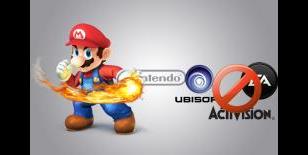
Yes, you read that correctly.
As we all know — third-parties haven't played well with Nintendo, for quite a while now; over 20 years to be exact. Yes — it's been THAT long.
Every generation, it seems to be the same old story; Nintendo announces new system with a myriad of the tried-&-true exclusives and only a handful of (decent) third-party titles to accompany them. While their handheld devices are arguably good on the number of third-party titles, their home consoles are pretty much starved.
That exact same scenario has played out with Nintendo's latest home system, the Wii U. While the "Regginator" promised that things would be different this time around, all we've seen thus far with the Wii U as it relates to third parties — is a whole convoy of games being announced to NOT COME to the system. It's been that way BEFORE it released DURING IT'S RELEASE and now here, after the fact. It seems like every week there's some other third-party dev or CEO giving their negative comments about the Wii U. In fact, just recently, Ubisoft's CEO blatantly said that Wii U owner shouldn't expect any more of the company’s "mature" titles to hit the system, with Watch Dogs being the end of the line.
It's not just them — many other companies have chimed in. SEGA, EA, Activision, Square Enix, Rockstar...the list goes on.
So — why exactly do third-parties blatantly avoid Nintendo systems with 95% of their games? Some blame it on Nintendo's lack of providing "top-of-the-line" hardware with all the muscle of the other guys, as well as the extra features to boot. Others blame it on Nintendo-hardware's general appeal to only the "casual" market — insisting that "mature" titles don't have a place on Nintendo systems at all. Like I said — this isn't new. This has been the case for quite a few generations now. In fact — let's go back — WAY back, to the times of the NES and Genesis era.
There's always been a fight between two mega-giants here in the gaming industry, and during the 3rd generation of video game consoles — it was Nintendo vs. SEGA. Nintendo had built themselves a mega-empire by means of franchises like Mario and Zelda, but SEGA fought back hard with franchises like Sonic. But outside from each camps' exclusive titles, third-party offerings were pretty much tit-for-tat. The thing is, even then, Nintendo systems portrayed themselves as being "casual", or "family-oriented" — as it was referred to at that point in time. On the other hand, SEGA was the place for all the teens and young adults; an attitude that was even portrayed with their mascot, Sonic, who was more of an anti-hero than a smiley-all-the-time, heroic Italian plumber.
This contrast was pretty much introduced with the big Mortal Kombat fiasco. The Genesis version of the game allowed players to really get the full "mature" factor by offering blood — which was censored out in the NES version. So as you can see, even from way back then, Nintendo has always seem to be "casual-gamer" HQ.
Now then, what does that have to do with the third-parties avoiding them? Well, that's only ONE PART of the story. It also has to deal with Nintendo's own franchises. As mentioned before, Nintendo had already built themselves an empire — an empire that even today, still bears some pretty sweet fruit. The majority of Nintendo franchises are still living on, and it's been over 5 generations (25+ years) — since the majority of them has been introduced. Despite their age — not only are new games still being made, but they're still selling in the millions. They're still getting 8s, 9s, and 10s when being reviewed. Their merchandise is still going out of stock on Club Nintendo. Little kids are still being introduced to gaming through these characters, and gaming veterans are still enjoying their childhood classics in new lights.
With standing power like that, Nintendo has always been successful, even when they're not. For instance — the Gamecube was Nintendo's lowest point in the console industry (no Virtual Boy, stay in your corner) — and yet, Nintendo still reaped profit from it and it's library full of pure gaming gems and many still consider to it one of the best systems they've ever owned. That was a system that Nintendo literally supported BY THEMSELVES. Third-parties hadn't avoided a Nintendo system to that extent, before the Gamecube.
Are you seeing the point yet? Nintendo has always been the ones who've had the task of making and carrying their systems, especially their home-consoles. This is the job for all console-makers; so yes, Sony and Microsoft are included in the bunch. Yet even so, just put either of those two in Nintendo's shoes. Imagine a world where Nintendo was like Sony and the PlayStation or even like Microsoft and the XBOX. Imagine if third-parties treated them like their best friend, and the likes of Mario and Zelda were only seen every now and then. Imagine if gamers weren't running to Nintendo ONLY for those franchises, but also for Need for Speed, Assassin's Creed, Battlefield, Call of Duty, Madden, FIFA, Mass Effect, and so many other third-party franchises.
Imagine if Sony and Microsoft instead had to carry their own systems on their own backs, with the majority of their libraries consisting of first-party exclusives. Trust me — they wouldn't be able to do it.
Nintendo's empire is simply too great and too timeless. I'm not being a fanboy when I say that — I'm being real. While Sony has big franchises like Uncharted, The Last of Us, LitteBigPlanet, and Gran Turismo — and Microsoft has franchises like HALO, Forza, and Gears of War: NONE of those could match the likes of Mario, Zelda, Kirby, Pokémon and Donkey Kong, which have literally stood the test of time.
Truth is; third-parties see Nintendo more as competition than business companions. When third-parties release their games on Nintendo systems, they have to compete with Nintendo's juggernauts. Why exactly do you think Watch Dogs was purposely left out of the loop on the Wii U? It would've been coming out in the same time frame as Mario Kart 8 — that's why. Why do you think Project CARS was also left out of the loop on the Wii U — because it'd be coming out way too close to Smash Bros. — that's why.
Nintendo's franchises are simply too big and cover too much ground for third-parties to handle. Also, third-parties can't make Nintendo dip into their pockets and hand over the green the same way that they can do with Sony and Microsoft. Just look at it; exclusive DLC, timed-exclusives, ad-campaigns, entire exclusive games — you know how much MILLIONS Sony/Microsoft have to shell out to companies like Ubisoft, EA, and Activision to get those perks? Why do they go through all the trouble? Because they know darn well they can't do it on their own. Imagine if PS4 wasn't being showered with the likes of Battlefield, Destiny, Assassin's Creed, Call of Duty, or Watch Dogs? Imagine if it's players mainly had to live off of Gran Turismo, inFamous, Killzone, LittleBigPlanet, The Order: 1886 and Knack? Imagine if Microsoft gamers had to mainly live off of HALO, Gears, Forza, and Sunset Overdrive?
Nintendo hasn't changed very much over the years. They're still stuck in their own ways, and continue to go on in this big fiesta of the industry — dancing to their own beat. Their loyal fans and younger comrades continue to stick with them. While everyone else is cheering and screaming at the likes of Gabe Newell, Suhei Yoshida and Phil Spencer — people like Iwata, Reggie, Sakurai, Anouma and Miyamoto are having tea in their own little circle. While Sony and Microsoft go at each other's throats, with EA, Ubisoft and Activision grin maliciously as they count their wads of cash — Nintendo is their playing patty-cake amongst themselves.
That's just how it is. Honestly, if they were to come out tomorrow with "Wii Ultimate"; possessing x86 architecture, 16GB of RAM, a Nivida TITAN graphics card, 12 cores, native 4K resolution, and 2TB hard drive, with an online system that sends the likes of PSN and XBL to their graves; third-parties still wouldn't care. They've been down that road already, and it didn't work out, so now, they're just doing their own thing. They've buddied up with devs like Platinum, SEGA, and Temco Koei to fill in the gaps with third-party exclusives, but trust me; never will you see the day that major third-party devs and publishers come running to Nintendo willingly.
The saying may go like: "If you can't beat em, join em" — but in Nintendo's case: "If you can't beat em, then just do you".
Microsoft announced its financial results for Q3 of fiscal year 2026, including an update on its gaming Xbox business and more.


Not looking good. Hopefully Asha Sharma is able to turn Phil’s disaster around.


To me it's still quite remarkable how they can cash-in 5.3bn in revenue in a single quarter, since their hardware is basically dead.

The charity event will be streamed live from Gamescom in August.
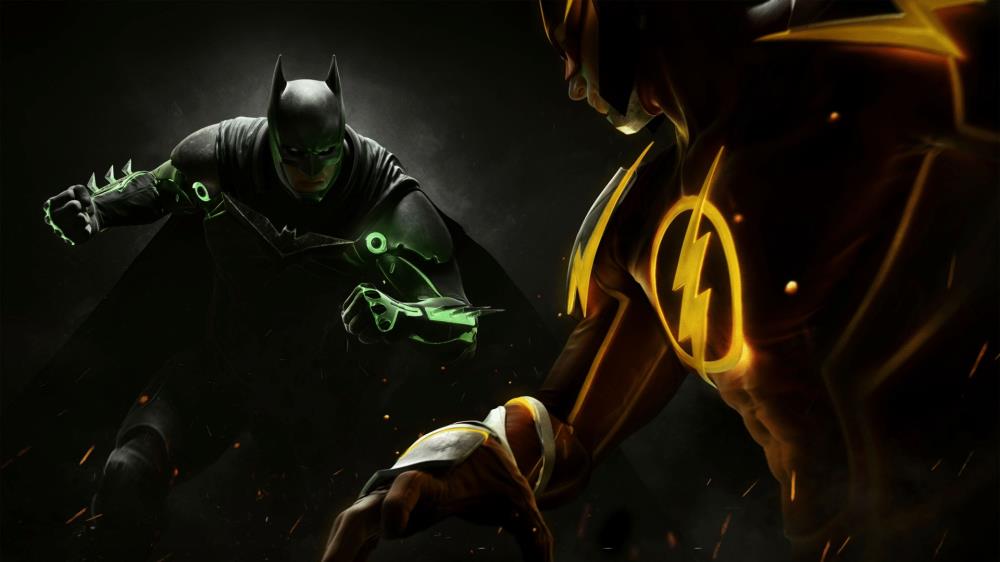
Thanks to the slip-up of an artist working on the title, we now have more evidence that a new Injustice game is in the works.




At the end of the day, it doesn't matter whose fault it is; it's Nintendo's PROBLEM. If they don't want to make as much profit as possible with a healthy third party (and no one WANTS to turn down more money), fine, but that's totally on them.
Nintendo hasn't made a system geared towards what developers want since the SNES. N64 still used cartridges, Gamecube had a controller with less functionality and a tiny disc, Wii was geared towards a fickle audience (along with having a control scheme too far off the beaten path and having very outdated hardware), and Wii U is significantly weaker than the competition and a controller that demands extra work be put into it (or else it gets criticized).
....So I must agree; it IS mainly Nintendo's fault. They simply have a LONG history of offering third parties less.
People can blame "weak ports" until they're blue in the face, but which came first? The chicken developers or the goose egg offerings to the developers.
No, I do not agree at all. It is not because Nintendo have uber powerful IPS that render all others invisible nor is it because Nintendo are simply happy playing by themselves.
The simplest answer is generally always the right one, it is about money. 3rd parties are losing interest because the consumers are not buying their games.
Why are the consumers not buying them?
Because the other two platforms it competes with are taking all the sales. They are doing this because they have
a. more powerful hardware;
b. simpler controls;
c. Better online infrastructure;
d. they advertise 3rd party games.
Nintendo took a risk, a risk to try pull in casuals from the Wii crowd using another different controller scheme and the 'Wii' name. It didn't work.
They will hopefully learn from this nextgen.
Okay. It's time to have the talk now. I have explained this a million times to gamers who can't seem to grasp why the 3rd parties continually half-ass their games and/or refuse to work with Nintendo and it's because it doesn't matter what Nintendo do. It wouldn't matter if they had the most powerful console on the marketplace or have the best online experience or have the best features because the 3rd parties won't work with them.
The pathetic truth of this matter is because Nintendo are unwilling to waste extravagant amounts of money to lure the 3rd parties to their platform; unlike their competitors Sony and Microsoft who seem very keen on getting "exclusive" content on the PS4 and XB1, whether it be "exclusive" content for Destiny or AC Unity for the PS4 or if it's Witcher 3 "exclusive" items or a timed "exclusive" like Rise of the Tomb Raider.
Sony and Microsoft's game divisions have been in the red for years because of these practices for years while the 3rd parties have grown richer and richer. So rich in fact; that they are utterly terrified of taking risks and wish to make as much money as possible by putting a game out on as many platforms as they can, having a particularly curious side-effect because of such a practice but that's another story for another day.
Nintendo is the only gaming company currently expanding right now compared to it's competitors. They've recently built a new HQ, they are constantly hiring and looking out for new talent and they're the only company that doesn't rely on 3rd parties to provide them with games because they aren't going to get them. If Nintendo ever did get solid support from the 3rd parties; they would be cutting off their nose to spite their face. Given the fact that propping up a company that refuses to comply with their demands compared to it's competitors who would willingly shell out millions to secure "exclusive" content from pieces broken off of a game doesn't make a lot of business sense does it?
You lost me at this point.
'Imagine if Sony and Microsoft instead had to carry their own systems on their own backs, with the majority of their libraries consisting of first-party exclusives. Trust me — they wouldn't be able to do it.'
I call bullshit.
Super Mario Galaxy for the Wii sold roughly 13 million units. Super Smash Bros for the Wii sold around the same. The Legend of Zelda: Skyward Sword sold 3.4 million units.
These numbers are nothing extraordinary for first party titles. Halo 3, for example, has sold nearly 15 million copies. Gears of War 3 sold 6 million units. Sony doesn't have a 'big hitter' that can sell over 10 million units like MS or Nintendo, but they have a lot more franchises that consistently sell well.
So yeah, if it came down to a battle of first party exclusives, Sony and MS could more than hold their own against Nintendo.